We build lithium-ion batteries for material handling. Which means we've spent a lot of time looking at what warehouses, distribution centers, and manufacturing plants actually run on, and how well it's working.
The answer, more often than not: a perfectly modern forklift powered by a battery invented before the American Civil War ended.
Lead acid. Born in 1859. Running your multi-million dollar operation in 2026.
This isn't a whiteboard argument. What follows is what our research consistently shows: the real, daily cost in lost shifts, wasted labor, floor space, and operational drag that lead acid quietly imposes on material handling businesses. And why lithium-ion paired with opportunity charging isn't just an upgrade. It's a fundamentally different game.
The 8-8-8 Trap That's Eating Your Shifts
Here's the operating reality of a lead acid battery in a warehouse: 8 hours to charge. 8 hours to cool down. 8 hours to run. That's the cycle. That's the box you're locked in.
Which means the moment you go to two or three shifts (which every serious operation eventually does) you are now forced to buy multiple batteries per truck just to keep one vehicle running.
According to industry data, a full conventional charge cycle takes approximately eight hours of charging followed by an eight-hour cooldown, which is why multi-shift operations typically need spare batteries to keep forklifts running while others charge. (Source)So you're not just buying batteries. You're buying battery rooms with ventilation systems, washing stations, specialized watering equipment, cranes to swap them, and trained staff to handle them.
These spaces often consume 5-10% of total warehouse footprint. Floor space that could be storing and moving product. (Source)How Lead Acid Charging Actually Works
Understanding why lead acid is so constraining starts with understanding the charging process itself. It's not just plug in and wait. It's a complex, multi-stage operation that requires dedicated infrastructure, constant monitoring, and creates significant safety hazards.
The charging process has three distinct phases:
- Bulk Charge (6-7 hours): High current flows into the battery until it reaches approximately 80% capacity. During this phase, the battery generates significant heat and hydrogen gas.
- Absorption Charge (1-2 hours): Voltage is held constant while current gradually decreases. The battery accepts charge more slowly as it approaches full capacity.
- Equalization Charge (periodic): An intentional overcharge applied weekly or bi-weekly to balance individual cells. This generates even more heat and gas, and must be done in a well-ventilated area.
After the 8-hour charge cycle completes, the battery is too hot to use. The mandatory 8-hour cooldown isn't optional. Using a hot battery accelerates degradation, voids warranties, and creates safety risks.
The Reality of Lead Acid Battery Charging Facilities
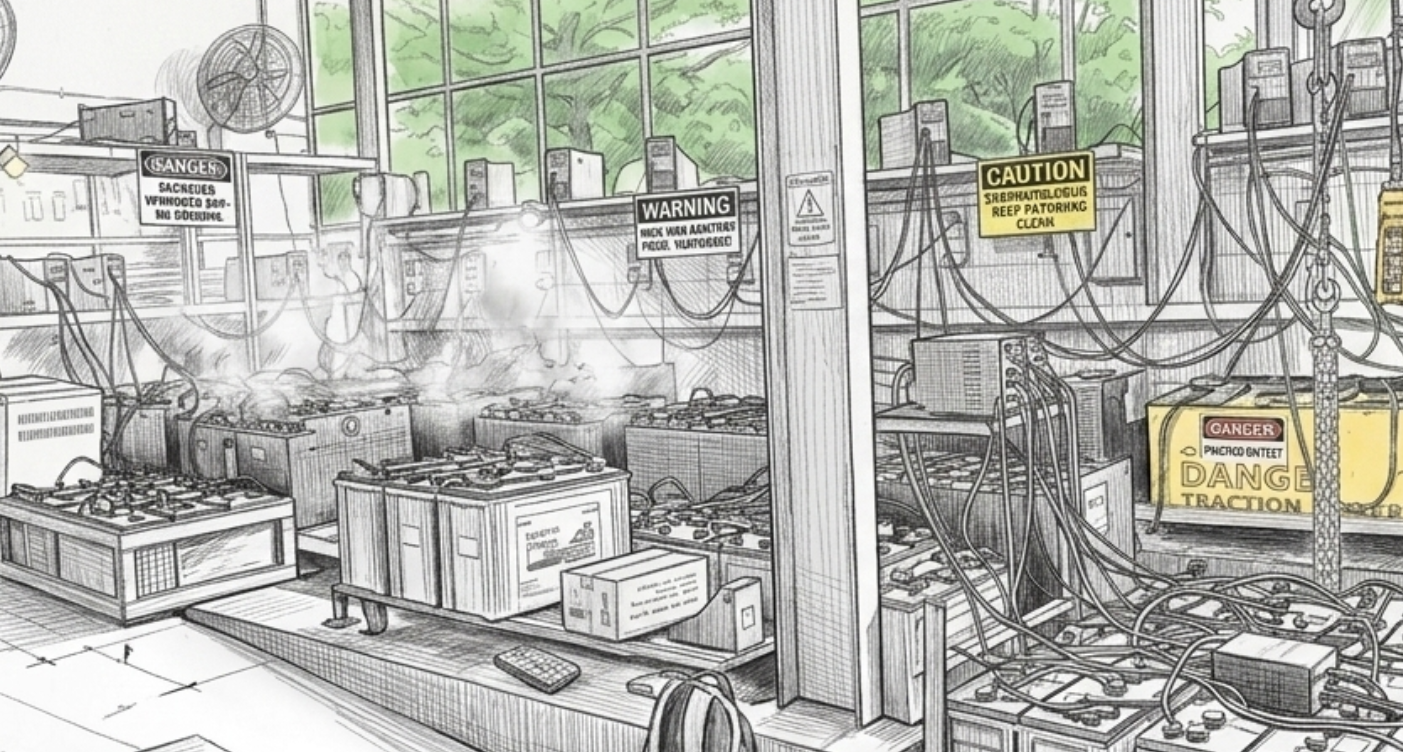
A typical lead acid charging facility: notice the extensive safety signage, ventilation requirements, and specialized equipment needed just to charge batteries safely
Safety Hazards in Lead Acid Charging
The charging room shown above illustrates why lead acid creates such operational complexity. Every warning sign represents a real hazard:
- Hydrogen Gas: Generated during charging, hydrogen is highly explosive. Ventilation systems must run continuously, and any spark near charging batteries can cause an explosion.
- Sulfuric Acid: The electrolyte is highly corrosive. Spills burn skin and eyes, damage floors and equipment, and require specialized cleanup procedures.
- High Voltage: Charging systems operate at dangerous voltages. Only trained personnel should enter charging areas.
- Thermal Runaway: Overcharging or damaged cells can trigger uncontrolled heating, potentially causing fires.
- Heavy Lifting Hazards: Each battery weighs 1,000-4,000 lbs. Swapping requires overhead cranes or specialized equipment, creating crush and drop hazards.
This infrastructure doesn't maintain itself. You need trained personnel to:
- Water batteries weekly (distilled water only, proper levels critical)
- Clean terminals and connections to prevent corrosion
- Monitor charging cycles and equalization schedules
- Inspect for cracks, leaks, and damage
- Test specific gravity and voltage across cells
- Maintain detailed logs for warranty compliance
- Respond to spills and safety incidents
This is before we even talk about the ongoing safety nightmare. Sulfuric acid spills, hydrogen gas emitted during charging, burns, and corrosion aren't theoretical risks. They're daily operational realities.
Lead acid batteries emit hydrogen gas primarily during charging, which creates a potentially explosive mixture, and their sulfuric acid electrolyte can burn skin and eyes. (Source)"You're not just buying a battery. You're buying a whole system of constraints: space, people, time, and risk."
Swapping Is a Patch, Not a Fix
The standard workaround for multi-shift operations on lead acid is battery swapping. Depleted battery? Pull it out, drop in a fresh one, get back to work. Simple on paper.
In practice, it's a productivity leak that never closes.
Battery swapping for lead acid systems typically takes 10-15 minutes per exchange, and multi-shift operations require 2-3 swaps daily. (Source)Per truck. Every day. Multiply that across a fleet and you're looking at tens of hours of lost productivity each week. Just moving batteries around.
Real-World Impact
One major equipment manufacturer calculated a $4,800 cost every single day due to lost productivity from swapping out lead acid batteries twice per shift.
After switching to lithium-ion and opportunity charging, they saved over $1 million every year by reclaiming that productivity. (Source)There's also a subtler problem nobody talks about: with lead acid, warehouse operators have no reliable way to gauge the battery's remaining run time. Rather than risk a dead machine on the floor, they swap sooner than necessary. And continuous or overcharging then shortens battery life, starting a cycle of cascading decay.
The real math: Swapping feels like a solution because you can see it working. But what you can't see is the accumulated cost. Idle trucks, diverted labor, damaged batteries, and the battery room eating your floor.
Opportunity Charging Changes Everything
Here's the insight that reframes everything: with lithium-ion, you don't manage batteries. You manage time.
Opportunity charging means plugging in whenever the truck is idle. During a break, a shift change, a lunch hour. No battery swap. No trip to the battery room. No cool-down period. Just top up and go.
Lithium-ion batteries are purpose-built for opportunity charging, handling frequent partial charges with no negative effects on lifespan. And in fact, opportunity charging can actually extend the overall life of an LFP battery.Lead acid, by contrast, degrades when you partial-charge it. Frequent partial charges generate heat and shorten battery life. It's literally the opposite problem. The thing that heals a lithium battery hurts a lead acid one.
A depleted LFP (lithium iron phosphate) battery can accept a full charge in one hour, and this charge doesn't need to happen in one session. It can be delivered across multiple short charging windows throughout the shift. (Source)Breaks, shift overlaps, docking pauses. Every idle minute becomes a charging window.
They also maintain consistent voltage and power output throughout the full shift. Lead acid degrades as it discharges, meaning your forklift is literally slower and weaker at the end of every shift.
How to Actually Run Two or Three Shifts on One Battery
The question we hear most often: "Can one lithium battery really get an operation through multiple shifts?"
Yes. And here's the mechanics of why.
The average warehouse shift has natural idle windows. Operator breaks (15-30 min), meal breaks (30-60 min), shift changeovers (15-30 min).
Opportunity charging takes advantage of exactly these windows: when employees are on lunch, taking a break, or switching shifts, the forklift can be plugged in and charged, so when the operator returns, the forklift has enough power until the next charging opportunity. (Source)The goal isn't a full charge at every break. It's restoring what was used. Top up 20% here, 15% there. By the time a shift ends, the battery is ready for the next operator without a pause.
What we recommend: Place opportunity chargers at dock doors, staging lanes, and break areas. Wherever trucks naturally pause. The charger becomes part of the workflow, not a detour from it.
And the battery life argument seals it: lithium-ion batteries generally start at 3,000 cycles and go up from there, amounting to a lifespan of five to seven years. Two to three times what you can expect from a lead acid battery.
One lithium battery will outlast two or three lead acid replacements. The math is simple. (Source)What This Looks Like in Practice: FMCG Warehouse Case Study
Theory is one thing. Real operations are another. Here's what happened when a leading FMCG warehouse in India switched to our lithium-ion batteries with opportunity charging.
The operation: 24/7 distribution center running 3 shifts with 42 electric forklifts. Previously running lead acid with battery swapping 2-3 times per shift.
The challenge: Battery room consuming 8% of warehouse floor space, 45 minutes of daily downtime per truck for swaps, inconsistent performance in final hours of each shift.
Battery State of Charge (SOC) - 30 Day Performance
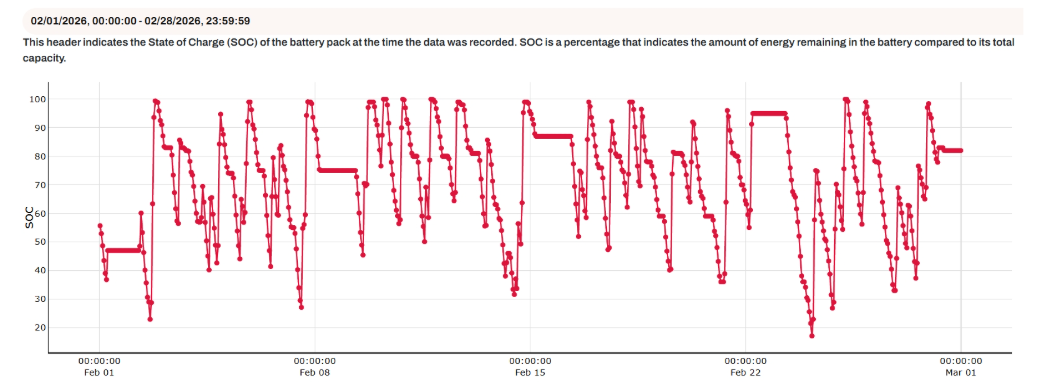
Real data from forklifts over 30 days showing consistent opportunity charging cycles with no battery swaps
What you're seeing: One month of continuous operation across the entire fleet. Notice the pattern. Batteries cycling between 20-100% SOC throughout each day. No swaps. No downtime. Just plug in during breaks and keep moving.
The vertical drops are overnight charging (full charge while facility is at lower capacity). The oscillations during the day are opportunity charges. 15-20 minute top-ups during breaks, shift changes, and dock pauses.
"We were skeptical about one battery handling three shifts. The data proved us wrong."
Operations Manager, Leading FMCG Distributor
The results after 6 months:
"The switch to lithium with opportunity charging was transformative. Our operators love it. No more waiting for battery swaps, no more wrestling with charging equipment. The forklifts perform consistently throughout the entire shift, which our guys immediately noticed."
"What surprised us most was the floor space. We converted the old battery room into additional staging area and picked up nearly 1,200 square feet of usable warehouse space. At Bengaluru real estate prices, that alone justified the investment."
"The Energy Company didn't just sell us batteries. They mapped our workflow, identified optimal charger locations, and trained our team. Three months in, uptime is better, costs are down, and we haven't had a single acid spill or hydrogen gas incident."
Key operational insights from this deployment:
- Charger placement matters: They installed opportunity chargers at 6 dock doors and 2 break areas. Trucks naturally pause at these points, making charging seamless.
- Shift overlap is your friend: During the 15-minute shift handover, trucks get a quick top-up while operators are switching.
- One battery works: Every single truck runs on one battery across all three shifts. No exceptions. No backups needed.
- Performance stays consistent: Unlike lead acid which weakens as it depletes, these batteries maintain full power output right down to 20% SOC.
Why Does Lead Acid Still Dominate?
Lead acid still powers the vast majority of electric forklifts in the field. The upfront cost is lower. Most procurement teams know it. The industry grew up on it.
But "we've always done it this way" is how you fall behind.
The total cost of ownership story is no longer close.
A Texas-based logistics provider with 50 Class 1 electric forklifts projected savings of approximately $2.9 million over an eight-year period after converting to lithium, with break-even achieved at 31 months. (Source)The objection we hear most is upfront cost. It's a fair concern. But that calculus only holds up if you ignore what operations are currently spending. On extra batteries, battery room infrastructure, watering systems, maintenance labor, lost productivity from swaps, and earlier replacement cycles.
Once those are on the table, the conversation changes fast.
"Lead acid is cheap to buy. Lithium is cheap to own. And in material handling, you own it for a decade."
For single-shift operations, the urgency is lower. For two or three shifts, the math has already turned against lead acid. The cost is just being paid slowly, invisibly, spread across hundreds of small inefficiencies that never get summed up on a single line item.
At The Energy Company, we built our batteries around this reality. Not because lithium is the industry trend, but because the operations we work with don't have time to manage batteries. They need to manage product.
That's what we're here for.

